hey there, welcome to my blog!
this is a brief corner where i collect shiny urban shards, wakefulness notes, rabbit holes in the park.
You: i made a retro desktop for my blog! 🌤️
Friend: <3!!!
You: just click around, windows move.
working title: The Radicals
In 1716, Qing dynasty (1644-1912) emperor Kangxi commissioned what would be known a posteriori as the Kangxi Dictionary, a monumental work that standardized the roots of language into 214 radicals (部首), or bùshǒu, as the essential conductors of meaning, and sometimes sound, in the composition of each Chinese character. These radicals, at once visual and semantic, function as opening keys: they unlock families of words that share the same logic, historical origin, or, as denoted by previous attempts to index radicals, an artificial relation of theological hierarchy. Even if dismal, the radicals' function is akin to the etymologies of alphabet languages, providing a semantic provenance upon which to build the visual and metaphoric dimensions of each word or character. In other words, the radicals signal a metaphorical scaffolding within the character, making possible an architecture that builds by stacking, securing a foundational meaning according to the semantic anchor in question.
My dissertation project, a collection titled The Radicals, takes the Kangxi radicals as its organizing principle. Each of the 214 poems, or pieces, will correspond to one radical. The ultimate book manuscript will comprise 214 poems, plus the subterranean pieces; however, my dissertation will include a substantial portion of those poems. In approaching the radicals as both linguistic fragments and conceptual roots, I treat language as an archaeological site where meaning is sedimented, assembled, and reconstituted by means of interpretation, and in this case, an imperfect translation into a language that shares similar grammatical functions with Mandarin.
The project seeks to make visible how the smallest units of writing—the radicals—carry histories of representation, often derived from the human body itself. Some originate in disembodied parts, inscribing the body into language through gestures of signification: the eye becomes a figure of contemplation; the hand, curiously, enters the pronoun “I,” suggesting the self is something that can be grasped.
In The Nick of Time (2021), within the chapter “Mandarin Primer,” Rosemarie Waldrop’s poem “The Radicals” lingers at this very threshold between matter and meaning. Waldrop writes that the radicals dwell “at the hub of language,” that they “nourish the phrases placed on sheets of paper, matching matter to manner.” (52) Beyond a factual taxonomy, she offers a miniature poetics of their composition: “They are arranged according to the number of strokes and speed of thought.” By likening them to “240 species of the theaceae family”—plants associated with tea and camellias—Waldrop reminds us that these radicals, like botanical roots, sustain a living system of language, nourishing the structure of meaning from within: “See camellia sinensis. The radicals form part of every character”(52). Waldrop’s ideas result significantly when it comes to acknowledging a system of “roots” that, on the general panorama of non-sinological languages, can otherwise be regarded as simple and uninviting linguistic facts of a remote language. In other words, even if brief, Waldrop’s consideration of this system, in a work of poetry, offers a necessary sense of permission for the consideration of the radicals in this work, since it is, in this research, the only use of the radicals in a poetic context I have come across.
The Radicals, whose genre can be approximated by the word poetry, aim to incorporate a plural disposition of other literary genres; hence, The Radicals will live online, on a Neocities website. Launched in 2013 as a revival of GeoCities, Neocities is a free and open-source web-hosting platform where users can build websites from scratch with HTML, and CSS, which, unlike standardized social media templates, work as nooks of the early internet experimentation, nostalgia, and the aesthetics of hand-coding. By hosting the collection within Neocities, and eventually acquiring a domain independent from the given one, I aim to join the web culture that treats the internet not only as a medium of mass distribution but as a malleable space that holds the melancholic aesthetics of times when graphics were arbitrary, imperfect, and less impacted by the kind of virtual politics that homogenize it all.
Publishing this work of poems online is also a matter of self-archiving. Unlike printed collections, its existence online recognizes a work of literature’s possibility of change, allowing constant changes, edits, and revisions, which a printed work can only afford, if fortunate, in a second edition; or, in its most likely unpublished manuscript condition, amongst other digital files, becomes prone to oblivion. Malleable as the internet is, this collection aims towards a poetics of the unfinished. Instead of the modern dread of what is left undone, this work seeks to relish in the possibilities that a lack of a clear ending, or sense of an ending, offers. This collection conceives the unfinished not as an imperfect fragment of a work that should have been completed, but as a form in itself. The unfinished does not exist solely in the obvious lack of an ending (read as the weaning of vehemence, yet also due to sudden death), but in the capacity of the work to formally continue ad infinitum, which is one of the possibilities that hypertext allows.
Although written largely in English, the hypertextual architecture of this poetry collection seeks a kind of personal post-national drift, withdrawing from the mediating role that “NAFTA literature” has lately occupied in critical perspectives on a work of literature written by a Mexican in the United States. In hypertext, the poems and subterranean pieces do not aim to “translate” nations for each other, as the publication of traditional books often encourages such a perspective, in part due to the publishing industry’s fetish for the subaltern story. Routed through networks, hypertext allows the collection to detach from a specific geographic location, existing in a space, with the exception of the exact locations of the servers, otherwise intangible.
At the most basic level, coding and literature both involve writing systems governed by syntax, semantics, and structure. Both code and poetry are performative, that is, they make something happen. While literature communicates through interpretation, code interprets its commands literally, communicating through execution. Yet in creative coding and digital poetics, these two forms converge. In other words, this project involves a “double” writing, where the visual outcome is but the result of the backend writing, that is, a kind of writing that, if done directly on a code program, as some of the poems have been crafted lately, involves the incorporation of both systems of writing.
As previously mentioned, beyond its forefront linear, grid-like structure, The Radicals will follow a non-linear hypertext structure in its second layer of pieces or poems, which are subadjacent to the radicals and do not necessarily adhere to the forefront 214 radicals. These subterranean pieces, or pages, will vary in literary genre, and will include Spanish to varying degrees, sometimes in coexistence with English, and sometimes amounting for the totality of the piece. Amongst the possible genres harbored under the radicals, the reader might find imperfect translations from Chinese poems (both modern and classic) into English and Spanish; diary entries; short and flash fiction; photos, inventories of authors' quotes, and other miscellaneous pieces. Despite the Chinese radicals' arbitrary arrangement, as discussed in the next section, they are fossils of metaphors past in plain sight. Hence, structuring this project around the radicals gives the poems, and subsequent layered pieces, a sense of provenance, a retrieval of often unforeseen associations between objects or concepts that in today’s age are otherwise dissimilar and algorithmically unmatchable. Such is the logic of classifying particles in Chinese; for instance, 条 (tiáo) has the radical 木, which means “wood,” a character used to classify items such as pants, rivers, and pasta, or anything resembling a tree branch.
On another ambit, this project acknowledges the interlocked sequence of Mexican authors who have searched, and perhaps found, something worth reviewing in China’s classic literary canon. Such is the case of José Juan Tablada (1871-1945), author of Li Po y otros poemas (1920), and Salvador Elizondo (1932-2006), author of the novel Farabeuf (1965), both sino-curious writers who found, respectively, through T’ang poetry, The Book of Changes, the Confucian canon, and Chinese torture, and the visual writing of Chinese, a form for their respective literary works. Additionally, it is worth noting that Salvador Elizondo was the first to translate into Spanish Ernest Fenollosa’s “The Chinese Written Character as a Medium for Poetry,” a text commented on by Ezra Pound, which sparked an interest in the visual structures of Mandarin. Despite their works not being multilingual, they rely on formal aspects of the Chinese language to structure poetry and prose in a dismally different language, such as Spanish. For this project, writing the poems and sub-pieces in both Spanish and English, following a pattern inspired by Mandarin, offers a confluence of appreciation for the different structural systems that each language provides. It also reunites me, for lack of a better verb, with what English once was for me, a lingua franca.
The layering of navigation, where the reader’s arbitrary gesture determines the trajectory of meaning, seeks to align with what theorists of electronic literature have described as an ergodic form of reading. In Cybertext (1997), Espen J. Aarseth writes that cybertext focuses on “the mechanical organization of the text, by positing the intricacies of the medium as an integral part of the literary exchange” (Web). In this sense, the reader becomes not only an interpreter but a “co-creator,” tracing pathways through a shifting field where, Aarseth argues, the reader effects a semiotic sequence: “this selective movement is a work of physical construction that the various concepts of "reading’ do not account for.” This unspecified impromptu non-linear movement through the cybertext, Aarseth precises, is “ergodic,” a compound of the Greek words “ergon” and “hodos,” meaning work and path respectively: to labor along one path is, necessarily, to foreclose another. Multiple reading paths, along with linking mechanisms and chunked text, are the three characteristics Katherine Hayes distinguishes as pertaining to hypertext or “technotext,” a concept Hayes proposes.
In the context of The Radicals, ergodicity becomes a metaphor for linguistic exhumation. Each poem requires the reader to navigate links, subtexts that simulate the user’s traversal through the realm of non-linearity. The act of reading folds into the acts of searching, tracing, and sometimes losing one’s way. “Trying to know a cybertext is an investment of personal improvisation that can result in either intimacy or failure,” declares Aarseth. In contrast with traditional literature, where the reader’s effort is “trivial, with no extranoematic responsibilities placed on the reader except eye movement and the turning of pages,” hypertext asks instead for a reading in which one might never reach every poem or sub-poem, akin to the incomplete nature of writing. Beyond its function as a dissertation project, The Radicals’ sublayering aims to never reach completion; it seeks to continue its subterranean bifurcations, either until the inevitable demise of its online hosting or my own will to expand it. Aarseth’s metaphor of the labyrinth is particularly generative for this project. He distinguishes between unicursal and multicursal labyrinths: the former is a single winding path toward a center, while the latter is a maze of branches that demands choices and induces disorientation. The Radicals seek both structures. The surface layer, the 214 poems, suggests a unicursal architecture, a grid of roots that can be read sequentially. Yet beneath this first layer, links branch into unclear and unprompted multicursal paths. This duality recalls Aarseth’s proposal to restore the dual meaning of the labyrinth, that is, to read texts as simultaneously unicursal and multicursal, linear and nonlinear.
The Kangxi Radicals is not the first of its kind. The system of indexing in Chinese writing can be traced back to the Shuowen Jiezi (說文解字), the early dictionary compiled by Xu Shen (ca. 58–149 CE) during the Eastern Han dynasty. As Uluğ Kuzuoğlu argues, Shuowen’s 540 radicals were not merely technical tools for retrieval but cosmological and political artifacts, designed to codify language under imperial authority. The arrangement itself was ideological: under the radical “yi” (一), meaning “one,” Xu Shen gathered words such as “yuan” (origin), “tian” (heaven), and “li” (government official), while omitting graphically similar but semantically discordant ones. Xu Shen’s system inaugurated a tradition in which language became a placeholder of governance by positioning the radical as a hinge between writing and a specific heavenward order. As Kuzuoğlu notes, this selective taxonomy reveals how the dictionary enacted power, encoding hierarchy by associating heaven and governance under the principle of unity; hence, the 540 radicals were heavily charged with numerological values, which, as Kuzuoğlu points out, explains why some radicals did not even have any characters arranged under them. Called “empty radicals” by Françoise Bottéro, they were intended not to help retrieve characters but “to complete the cosmos.” Xu Shen’s indexical arrangement, in short, stood as nothing less than an index for the universe. Centuries later, Mei Yingzuo’s 1615 Zihui reorganized this infrastructure into the now-familiar system of 214 radicals, later canonized in the Kangxi Dictionary (1716). Mei’s design, although numerically reduced, was still influenced by the numerological and religious cosmologies of earlier systems, reusing 168 radicals from Buddhist lexicons, such as the Longkan shoujing (龍龕手鏡). In other words, to read or write under Kangxi was therefore to inherit a cosmology of classification: a system that, while appearing to organize words, ordered thought through the establishment of relational hierarchies amongst words. Subsequent centuries saw radical reformulations that reflected changing political and religious orders. In 776, Tang scholar Zhang Can created a 160-radical index to reassert imperial control over proliferating phonetic and regional variants, aligning classification with the newly standardized kaishu script. Buddhist lexicons, such as the Longkan shoujing, later reduced and reconfigured the system to accommodate Sanskrit loanwords, demonstrating how theological translation also influenced the infrastructure of meaning. Thus, even the “empty radicals” with no characters under them functioned not as gaps but as cosmic placeholders, signifying that classification itself was an act of worldmaking. Xu Shen’s indexical arrangement, in short, stood as nothing less than an index for the universe.” (27) Hence, what persists in the 214 radicals is not only a graphic key but a sedimented provenance of past epistemes. In this project, I aim to utilize these former metaphors in the context of a collection that inevitably classifies in its process of confection.
Detractors of the Kangxi radicals, as Kuzuoğlu notes, argued that these were confusing and required too much time to access information because the process of locating the radical, which is typically found on the left or top of a given character, was not straightforward. What allowed this system to endure was not its technical efficiency but its entanglement with imperial politics: the Manchu emperor’s patronage of Han literary culture ensured its adoption as an official index, transforming a private scholarly tool into an imperial linguistic archive. “Old infrastructures bled into new ones, creating a layering of infrastructures over time,” (28) Uluğ Kuzuoğlu reminds us, insisting the radicals were “a technology of power,” (27) especially when they were reformed, a process in which some words got their radical re-assigned. For instance, a predilected slogan of the 1920s was “Down with the Kangxi Dictionary (dǎdǎo Kāngxī zìdiǎn)!” (30). By the end of the essay, Uluğ Kuzuoğlu argues that the values embedded in the Kangxi radicals did not vanish with modernization but instead transformed under the pressures of industrial capitalism and, later, digital infrastructures. The rise of telegraphy, typewriters, and computer input methods fractured the earlier unity between writing and meaning, turning indexing into a technopolitical tool rather than a cosmological order. Yet Kuzuoğlu insists that these infrastructures retain their “residual marks”—the historical traces of previous epistemes. Even in today’s cyberinfrastructures for Chinese, he writes, one can detect continuities with the Shuowen jiezi: both encode new habits and values appropriate to their eras. “The cyberinfrastructures that are currently being developed for Chinese,” he concludes, “are indeed similar to Shuowen in that they embody new values and engender new habits in an increasingly digital age.”
Aarseth, Espen J. “Introduction: Ergodic Literature. The Book and the Labyrinth.” Cybertext: Perspectives on Ergodic Literature, The Johns Hopkins University Press, 1997. WilliamWolff.org,
Balazs, Etienne. Chinese Civilization and Bureaucracy: Variations on a Theme. Edited by Arthur F. Wright, Yale University Press, 1964.
Hayles, N. Katherine. Writing Machines. MIT Press, 2002.
Kuzuoğlu, Uluğ. “INDEXING SYSTEMS.” In Literary Information in China: A History, edited by JACK W. CHEN, ANATOLY DETWYLER, XIAO LIU, CHRISTOPHER M. B. NUGENT, and BRUCE RUSK, 25–35. Columbia University Press, 2021. http://www.jstor.org/stable/10.7312/chen19552.10.
Waldrop, Rosemarie. The Nick of Time. New Directions, 2021.
Hay cosas que solo pueden venir de un profundo tedio, como cortar el pasto, molestar gente en línea o fumar en la cama. Hay cosas que se nos revelan con la luz diurna, semejante a un daguerrotipo que develamos cada día; nuestra rutina consiste en entender el progreso de los astros en la medida en la que nos dan luz, mientras nos brindan un desvarío que no tiene fin, que pulula igual que las aves, o las hadas falsas de 1917, cuando Elsie Wright y Frances Griffith, dos primas de Cottingley, cerca de Bradford, crearon hadas diminutas, se tomaron fotos con ellas en el bosque y, fingiendo demencia, se sorprendieron en el develado de las dos primeras fotografías, como diciendo, las hadas existen.
De nada sirve decir que las hadas no existen. Decir que esos seres alíferos se posan en las ventanas de noche sería como decir que escribo esto en luna menguante, y esta tarde perdí algunos anillos en las olas breves que colisionaron contra mí. De nada sirve decir que las olas se fugaron. Se fueron hacia las dunas, se hundieron en sus arenas hirvientes. Esta tarde algunas flores en el cementerio crecieron a la sombra de un ahuehuete. El calor era verosímil, igual que las jaurías de moscos empecinados en detener su vuelo sobre piel humana. El lema se volvió inaudito entre su vuelo, una consigna alada, una pirueta mal hecha. Las hadas volaban entre los árboles inmensos: de nada servía decirlo, eran invisibles a cualquier vaho que procediera de nuestras bocas. De nada servía lo demás, lo que los demás querían decir en fila india en las dunas. Yo tampoco quería decirlo. Me parecía pecaminoso. Inverosímil. Yo me decía, no tengo mente. No tengo ausencia. Tengo desvelo, y pereza. Una pereza que no se quita, profunda, anclada a los huesos, una pereza ambiciosa de sí misma, conservada en formaldehído.
Entre los quejidos de las habitaciones estaba Julián. Julián y su sombra de hacinamiento mental y una perfección moral que era difícil de tragar a veces, pero que vivía con él y entonces había que aceptar su rectitud, su vocación por ser políticamente correcto. En fin. Julián salía de casa en su Fiat 500 color vino. Me decía que el autocinema estaría abierto por la noche y que había que echarle un ojo a las películas somnolientas que alumbraban la pantalla gigante en ese estacionamiento en Insurgentes norte. El norte de la ciudad me daba flojera, pero casi todos mis amigos vivían en el norte, a contra-espalda. Yo no. Yo vivía en el sur, y por lo mismo, me daba pereza salir por un café al otro lado de la ciudad, esa escuadra mal trazada de nombres irregulares “old-fashioned.”
A los pocos meses, Julián se salió de la universidad. Nadie volvió a hablar de él. Algunas cosas quedaron soterradas en esos pasillos exhaustos de sí mismos, retacados de estudiantes y venta de cigarros sueltos y humo en los balcones abiertos de la facultad. Nada se dijo cuando María dijo que Julián la estaba pasando dos tres en esa nueva universidad a la que se matriculó en los meses subsecuentes a su partida. María no dijo nada cuando las hadas tomaron partido por Julián. Solo dijo eso. Las hadas tomaron partido por Julián. En las escalinatas de noche el alumbrado creaba sombras vagabundas.
El desvelo parecia tocar a la puerta. Las llaves del agua estaban cerradas con mas firmeza que de costumbre, y el sol otoñal se resistia al invierno prematuro de nuestras buhardillas subterraneas, al igual que los animales allá afuera, de pelajes pintos y esponjosos ante los vientos del lago, procedentes de sus aguas remotas y apenas vivas, apenas coloradas por todos nuestros recuerdos posados sobre su manto superficial, hielos a la deriva en vasos de cristal, una deriva continental, y arena rezagada entre el pasto ya casi marchito.
Era casi el desvelo, la desidia de siempre, empecinada en empolvar los dias sucedáneos. Aquí, en este departamento subterraneo, los pasos de los vecinos justo arriba de nosotros eran señales de algo que llevaba tiempo rumiando en silencio, que todos somos iguales. En el sillon azul del abuelo de A, herencia tambien prematura, cuando vivia en ese otro departamento diminuto en un tercer piso, y las ventanas daban a la esquina de la 18 con Racine, epicentro de cualquier evento desafortunado, con excepcion de dos cuadras adelante, donde hubo un hit-and-run, frente a la peluqueria de los gatos atigrados, como diria mi padre si los viera cuidar las sillas del salon de belleza que resguardan como cancerberos felinos.
field notes: on listening to cracked clay, rain, and other omens.
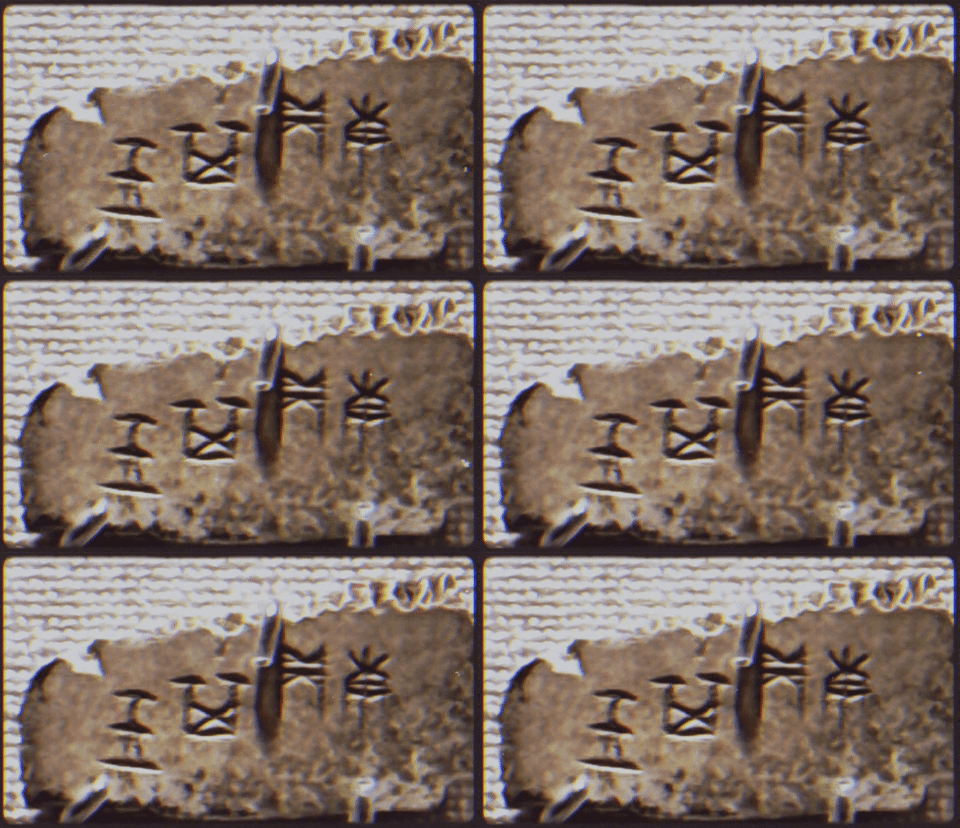
Alex and I went to the Art Institute to see oracle bones. This is probably the fifth time we do this. In this fragment, on the far left, you can clearly see what would become 王, wang, king; also one of China's most popular surnames. I'm not sure of the others.
I remember telling A about the carving. How current writing, despite calligraphy and fonts, preserves the initial contact of utensil and material.